Statutory Sick Pay (SSP) is one of the most important workplace protections available to employees in the United Kingdom. It provides a minimum level of financial support when an employee is unable to work because of illness or sickness absence. For many workers, statutory sick pay helps cover essential living costs while they recover and return to employment.
The Statutory Sick Pay Rules UK 2026 introduce some of the most significant changes seen in recent years. These reforms are designed to expand access to sick pay, support lower-paid workers, and simplify entitlement rules for employers and payroll teams.
At Salam Immigration, we regularly assist individuals and businesses across the UK with employment-related matters that intersect with immigration status, work rights, and compliance requirements. As a UK-based firm with extensive experience supporting workers and employers, we understand the importance of staying informed about legal changes that can affect income, employment security, and workplace rights.
In this guide, we explain everything you need to know about the Statutory Sick Pay Rules UK 2026, including who can receive statutory sick pay, how much SSP is worth, employer responsibilities, and what alternatives may be available if SSP ends or you do not qualify.
What Has Changed in Statutory Sick Pay from April 2026?
The biggest reforms to statutory sick pay take effect from 6 April 2026. These changes are intended to extend protection to more employees and ensure that workers who become ill can access financial support more quickly.
One of the most important updates is that SSP is payable from the first qualifying day of sickness. Under previous arrangements, employees often had to wait before becoming entitled to statutory sick pay. However, waiting days for SSP are eliminated starting April 2026. This means that SSP payments start from the first qualifying day of sickness, providing faster financial support for workers facing illness.
Another major change is that the earnings threshold for SSP is removed from April 2026. Historically, employees needed to meet the lower earnings limit before they could qualify. From April 2026, many lower-paid workers who were previously excluded will now become eligible to receive statutory sick pay. This is expected to benefit workers in part-time roles, flexible employment arrangements, and certain low-income occupations.
The reforms also affect the way statutory sick pay is calculated. Statutory Sick Pay is £123.25 per week from April 2026. However, SSP is no longer simply a flat weekly rate for everyone. Instead, SSP is the lower of £123.25 or 80% of earnings. This creates a more proportionate system for employees whose average weekly earnings fall below the full statutory amount.
For employers, these changes mean reviewing payroll systems, employment contracts, sickness reporting procedures, and HR policies. Organisations that currently operate contractual sick pay schemes should also assess how their arrangements interact with the updated SSP framework.
The April 2026 reforms can be summarised as follows:
| SSP Rule | Position from April 2026 |
| Effective date | 6 April 2026 |
| Waiting days | Removed |
| Lower Earnings Limit | Removed |
| SSP entitlement | From first qualifying day |
| Weekly SSP rate | £123.25 |
| Calculation method | Lower of £123.25 or 80% of earnings |
| Maximum payment period | 28 weeks |
These changes represent a significant expansion of statutory sick pay coverage and will affect both employers and employees across the UK workforce.
Who Is Eligible for Statutory Sick Pay in 2026 and How Much Will You Receive?
Understanding whether you qualify for statutory sick pay is the first step in determining what financial support may be available during a period of sickness. The April 2026 reforms have expanded access to SSP, meaning more employees can receive statutory sick pay than under previous rules.
What is Statutory Sick Pay and Eligibility Criteria for It in 2026

The eligibility criteria for statutory sick pay remain largely based on employment status, but the new rules remove some barriers that previously prevented lower-paid workers from qualifying.
To qualify for SSP, you must be an employee. Workers who are genuinely self employed are not covered by the statutory sick pay system. Instead, they may need to explore alternative benefits or other forms of financial support if illness prevents them from working.
You must have worked for your employer to qualify for SSP. In addition, workers must be employed for tax purposes to qualify. This means the employment relationship must be recognised through PAYE arrangements rather than self-employment.
A worker must also meet the minimum sickness requirement. You must be ill for at least one full working day to qualify for SSP. The first full day of absence due to illness is often referred to as the first qualifying day of sickness.
One of the most significant changes introduced in April 2026 is that the earnings threshold for SSP is removed from April 2026. Previously, employees had to earn above the lower earnings limit before becoming entitled to statutory sick pay. The removal of this threshold means more employees, including some lower-paid workers, can now qualify.
Importantly, workers on zero-hours contracts can still claim SSP. This change is expected to benefit individuals working flexible schedules, seasonal jobs, and irregular working patterns. An agency worker may also qualify, provided the relevant employment and tax conditions are satisfied.
Employees should remember that being absent from work does not automatically mean they will receive statutory sick pay. They must follow reporting requirements, satisfy the eligibility criteria, and comply with their employer’s sickness reporting procedures.
Understanding Qualifying Days
A key concept within the SSP rules is the distinction between a qualifying day and qualifying days.
A qualifying day refers to a day on which an employee would normally be expected to work under their employment contract. Qualifying days refers to the pattern of working days that regularly applies to the employee.
For example, if an employee normally works Monday to Friday, those five days are their qualifying days. If sickness absence occurs on a Wednesday, that Wednesday becomes the qualifying day relevant to the claim.
This distinction becomes particularly important for workers with irregular schedules, shift-based roles, or a zero hours contract. Employers often need to review work patterns carefully to determine the correct SSP entitlement and pay period calculations.
Under the new rules, SSP is payable from the first qualifying day of sickness and SSP payments start from the first qualifying day of sickness. This is a significant departure from previous arrangements involving waiting days.
It is worth noting that under the historic system, SSP has a waiting period of 3 days for initial claims unless illness was previously linked. However, waiting days for SSP are eliminated starting April 2026, meaning eligible employees no longer face a delay before statutory sick pay becomes payable.
How Much is Statutory Sick Pay in 2026?
The amount of statutory sick pay an employee receives depends on their earnings and the updated SSP rate introduced for the 2026 tax year.
Statutory Sick Pay is £123.25 per week from April 2026. The government has confirmed that the SSP rate increases to £123.25 per week from April 2026.
However, not every worker will automatically receive the full flat weekly rate.
Under the new calculation model, SSP is the lower of £123.25 or 80% of earnings. In practical terms, employees will receive whichever amount is lower. This approach is designed to ensure that SSP remains proportionate for workers with lower income levels.
When calculating statutory sick pay, employers must assess the employee’s average weekly earnings. Average weekly earnings are calculated over the previous 8 weeks. Payroll teams will typically review the employee’s normal wages during the relevant period to establish the correct statutory amount.
For most employees, statutory sick pay will continue to be paid through payroll in the same way as ordinary earnings. SSP remains subject to normal deductions for tax purposes, and employees should expect SSP payments to appear within their usual pay period, while those with immigration conditions can prove their immigration status and right to work when required by employers.
Examples of SSP Calculations
The following examples demonstrate how statutory sick pay may be calculated under the April 2026 rules.
| Employee Type | Average Weekly Earnings | SSP Calculation | Weekly SSP |
| Full-time employee | £600 | Lower of £123.25 or 80% (£480) | £123.25 |
| Part-time employee | £200 | Lower of £123.25 or 80% (£160) | £123.25 |
| Low-income employee | £120 | Lower of £123.25 or 80% (£96) | £96 |
For example, an employee whose average weekly earnings are £600 would receive the full weekly rate of £123.25 because 80% of earnings exceeds the statutory amount. By contrast, an employee earning £120 per week would receive £96 because 80% of their earnings falls below the flat rate.
Where an individual has more than one employment arrangement, each employer may need to assess entitlement separately. National insurance records and earnings from each employment relationship may affect calculations, particularly where different payroll systems are involved.
How Long Can You Receive Statutory Sick Pay?
While the new sick pay rules UK expand access, the maximum payment duration remains unchanged. SSP is paid for up to 28 weeks. In addition, SSP can be paid for a maximum of 28 weeks in total. Once that limit is reached, SSP ends and alternative support may need to be considered.
The 28-week limit applies across one period of sickness and may also apply to linked periods of sickness. Linked periods arise when separate absences are connected under SSP rules. We discuss linked periods in more detail later in this guide.
Employees approaching the end of their entitlement should consider what benefits or financial support may be available. In some circumstances, you may be eligible for Employment and Support Allowance if you are not eligible for SSP.
Understanding these entitlement rules is important for both employers and employees. Employers must ensure statutory sick pay is paid correctly, while employees should be aware of their rights, obligations, and the support available if a period of sickness extends beyond the SSP limit.
Fit Notes and Medical Evidence Requirements
Medical evidence plays an important role in the statutory sick pay process. While employees are entitled to statutory sick pay when they meet the eligibility criteria, employers are also entitled to request appropriate evidence to verify a period of sickness absence. Understanding when evidence is required and what documents are acceptable can help both employees and employers avoid disputes.
When Is Medical Evidence Required?
For short-term illness, employees do not normally need to provide medical evidence immediately. Instead, workers can usually self certify their sickness during the initial stage of absence.
However, proof of sickness is required for absences over 7 days. Likewise, a fit note is required after seven days of sickness. Once an employee has been absent for more than seven consecutive days, including non working days such as weekends and bank holidays, the employer may ask for formal evidence to support the statutory sick pay claim.
The employee should also remember that reporting obligations still apply from the start of the absence. Employees must notify their employer within seven days of absence. In addition, you must notify your employer within seven days of absence and you must follow your employer’s rules for notifying them of sickness. Many employers specify reporting procedures within an employment contract, staff handbook, or sickness absence policy.
Failure to follow these procedures could delay SSP payments or create complications when an employer assesses entitlement.
What Is a Fit Note?
A fit note, formally known as a Statement of Fitness for Work, is the primary document used to confirm that an employee’s illness affects their ability to work.
The fit note replaced the older sick note system and provides more flexibility for employees and employers. Rather than simply stating that a person is unfit for work, a fit note may indicate that an employee could potentially return to work if certain adjustments are made.
For example, a healthcare professional may recommend:
- Altered working hours
- Temporary changes to duties
- Reduced physical activity
- A phased return to work
These recommendations can help employers manage sickness absence more effectively while supporting employee wellbeing and maintaining productivity.
Where workplace adjustments are not possible, the fit note will continue to support the employee’s entitlement to statutory sick pay during the relevant period.
Who Can Issue a Fit Note?
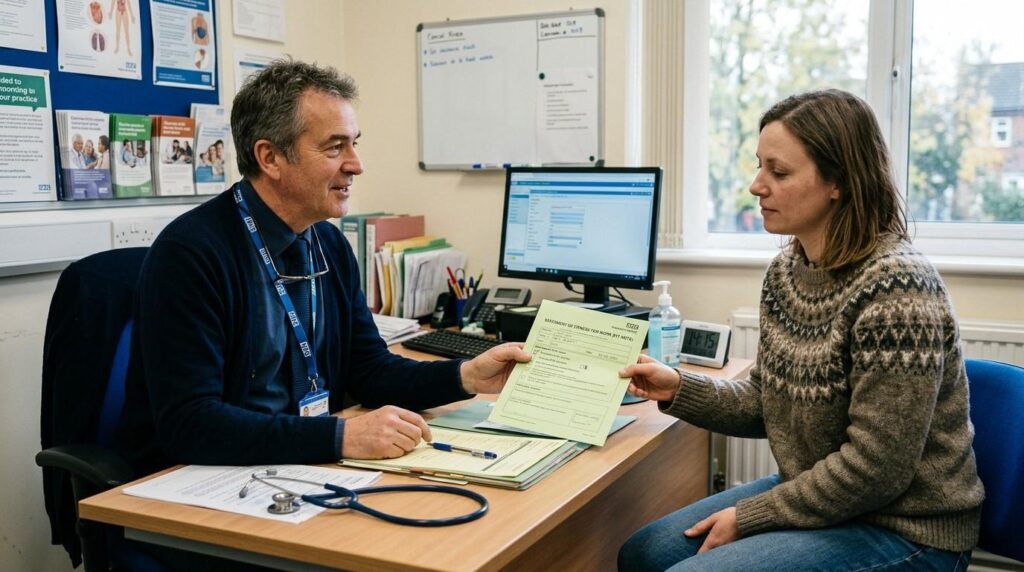
Employees should obtain a fit note from an authorised healthcare professional. In the UK, fit notes may be issued by various medical practitioners involved in a person’s care.
This can include:
- General Practitioners (GPs)
- Hospital doctors
- Registered nurses
- Occupational therapists
- Pharmacists in certain circumstances
- Physiotherapists
The expansion of authorised professionals has made it easier for employees to obtain medical evidence without unnecessary delays.
Employers should ensure that managers and HR teams understand which healthcare professionals are authorised to issue fit notes, particularly when reviewing SSP claims or contractual sick pay arrangements.
Digital Fit Notes and Online Medical Evidence
The NHS increasingly provides fit notes in digital format. Employees may receive their fit note electronically and forward it directly to their employer by email or through an internal HR system.
Digital fit notes carry the same legal status as paper versions and are widely accepted across UK workplaces. For employers, digital documentation can simplify record-keeping and reduce administrative delays.
As workplace processes become more digital, organisations should ensure their sickness reporting systems can accommodate electronic fit notes and other forms of supporting evidence.
Best Practice for Employees and Employers
Employees should keep copies of any fit notes, medical correspondence, or absence records relating to their illness. This can be helpful if questions arise regarding statutory sick pay entitlement, linked periods of sickness, or benefit claims.
Employers should maintain accurate records of:
- The day of sickness absence
- Employee notifications
- Fit notes received
- SSP payments made
- Periods of sickness covered by SSP
Good record-keeping helps ensure compliance with SSP rules, reduces the risk of disputes, and provides evidence if HMRC requests information regarding statutory sick pay payments.
For most employees, obtaining a fit note is a straightforward part of the sickness reporting process. Understanding when evidence is required and providing it promptly can help ensure statutory sick pay is paid correctly and without interruption.
Linked Periods of Sickness and the 28-Week SSP Limit
Not every sickness absence occurs as a single uninterrupted period. Many employees return to work after an illness, only to experience a recurrence of the same condition or another period of sickness shortly afterwards. In these situations, the rules relating to linked periods become particularly important.
Understanding the 8-Week Linking Rule
Under SSP rules, periods of sickness are generally linked if they are separated by eight weeks or less.
If an employee returns to work but experiences another qualifying period of sickness within eight weeks, the new absence may be connected to the previous one. The employer must then treat both periods as part of a single SSP record.
This rule is designed to ensure consistency when assessing entitlement and prevents employees from repeatedly restarting a new SSP claim every time they experience a short return to work.
The linking rule can also affect waiting periods under previous SSP arrangements. Historically, employees who have been off for a similar period recently may not have to wait 3 days for SSP. This was because linked periods could be treated differently from entirely new sickness claims.
It is important to remember that SSP has a waiting period of 3 days for initial claims unless illness was previously linked. However, following the April 2026 reforms, waiting days for SSP are eliminated starting April 2026, meaning SSP becomes payable from the first qualifying day of sickness for eligible employees.
Even though waiting days have been removed, the concept of linked periods remains relevant because it still affects the overall calculation of entitlement and the 28-week maximum payment limit.
What Happens When SSP Ends?
Long-term illness can create financial uncertainty for employees once their statutory sick pay entitlement is exhausted.
When an employee reaches the maximum entitlement period, SSP ends regardless of whether they are medically fit to return to work.
At this stage, employers must take specific administrative steps. Employers must issue an SSP1 form if SSP is not payable. The SSP1 form confirms that statutory sick pay has ended or cannot be paid and may be required when applying for alternative benefits.
Employees whose SSP ends should explore other sources of financial support as early as possible. Depending on their circumstances, they may qualify for:
- Employment and Support Allowance
- New Style Employment and Support Allowance
- Universal Credit
- Other state benefits linked to illness or reduced work capability
As noted earlier, you may be eligible for Employment and Support Allowance if you are not eligible for SSP. Individuals with long-term health conditions should assess their options before their statutory sick pay entitlement runs out.
Statutory Sick Pay Rights for Migrant Workers in the UK
Many migrant workers are unsure whether their immigration status affects their entitlement to statutory sick pay. In most cases, eligibility depends on employment status rather than nationality.
If you are legally employed in the UK and meet the statutory sick pay eligibility criteria, you may be entitled to receive SSP in the same way as any other employee. This includes many workers holding Skilled Worker visas and related work routes like Health and Care Worker visas, family visas, and other forms of permission to work.
To qualify, you must be employed for tax purposes, have worked for your employer, and satisfy the relevant sickness and notification requirements. Where applicable, your employer will calculate SSP based on your average weekly earnings and pay it through payroll.
Migrant workers should also ensure their employment records and national insurance contributions are accurate, as these may affect access to certain benefits and forms of financial support beyond statutory sick pay.
Workers employed on temporary work visa or contracts, flexible schedules, or through recruitment agencies should not assume they are excluded from SSP. Depending on their circumstances, an agency worker or someone working under a zero hours contract may still qualify for statutory sick pay.
It is also important to understand that statutory sick pay is separate from other forms of support. Depending on your circumstances, you may encounter benefits such as statutory maternity pay, maternity allowance, Employment and Support Allowance, Universal Credit, or eventually the state pension. Each benefit has its own eligibility rules and should be assessed individually alongside separate considerations about UK work visas.
If illness affects your ability to work, notify your employer as soon as possible and follow the company’s reporting procedures. Delays in reporting sickness during the first seven days of absence can create unnecessary complications when assessing entitlement. Under the new SSP rules, eligible employees may become entitled to payment from the first day of qualifying sickness absence, making timely notification even more important.
For migrant workers, understanding workplace rights is just as important as understanding immigration requirements. If you are planning to relocate, guidance on moving to the UK and long-term settlement options is also invaluable. Seeking professional advice early can help prevent misunderstandings and ensure you receive the support to which you are legally entitled.
Need Advice on UK Employment and Immigration Matters?
At Salam Immigration, we understand that employment rights and immigration status often overlap. Whether you are a migrant worker seeking guidance on your right to work, a visa holder concerned about long-term sickness absence, or an employer managing a diverse workforce, our team can provide practical and reliable support.
We assist individuals and businesses across the UK with immigration applications, sponsorship matters, compliance issues, and employment-related concerns that may affect immigration status. Our team includes dedicated immigration solicitors in Birmingham, London, and Manchester supporting complex applications. Our approach focuses on clear advice, tailored solutions, and helping clients navigate complex rules with confidence.
If you need professional guidance regarding your immigration status, work rights, visa options, or related employment matters, contact Salam Immigration to discuss your circumstances with an experienced adviser.
Get Expert Guidance on UK Employment Rights
Visa · Settlement · Legal Support