If you hold a UK spouse or partner visa and your 30-month leave is approaching its end, the next step is an FLR(M) application for you.
An FLR(M) is the standard way to extend a spouse visa, civil partner visa, or unmarried partner visa from inside the UK. It grants 30 months of further leave to remain on the 5-year partner route toward indefinite leave to remain.
Most applicants should submit their FLR(M) application within the last 28 days before their current visa expires. Applying in time triggers Section 3C protection, which keeps your right to work and stay in the UK while the Home Office decides.
At Salam Immigration, our family visa experts can help you apply for FLR(M) and ensure the best outcomes. This FLR M application guide walks you through every part of the process: who needs to apply, when to submit, what it costs in 2026, and how to avoid the mistakes that lead to refusals. We wrote it in plain English so you can follow each step with confidence.
What Is FLR(M) And How It Fits Your UK Partner Visa Journey
FLR(M) stands for Further Leave to Remain (Marriage/Partner). It is a specific legal immigration process in UK immigration and family law, used to extend a spouse or partner visa from inside the UK. If you entered the UK on a 30-month partner visa and want to continue living here with your partner, this is the form you need.
An FLR(M) application is primarily a UK immigration term. It applies to partners of a British citizen, Irish citizen, someone with settled status (including under the EU settlement scheme), pre settled status, indefinite leave to remain, refugee status, or humanitarian protection. The form covers spouses, those in a civil partnership, and anyone living with a partner as an unmarried partner.
The 5-year partner route works like this: you receive an initial 30-month entry visa, then extend it for another 30 months via FLR(M). After five years of continuous residence (60 months total), you become eligible for indefinite leave to remain.
An FLR(M) application usually leads to settlement in 5 years, compared to 10 years with the FLR(FP) route. FLR(M) serves as a vital second stage on that five-year path toward permanent residence.
Who Needs To Submit An FLR(M) Application?
You should apply for FLR(M) if you are already in the UK on a partner visa (as a spouse, civil partner, or unmarried partner) and your current visa is due to expire. FLR(M) applications focus on recognising established relationships as a basis for immigration status. This is the correct route if you want to stay in the UK with your partner and continue on the 5-year path.
Typical examples include:
- Extending a spouse visa after your initial 2.5 years in the UK
- Switching from a Student, Skilled Worker, or Graduate visa into the partner route while in the UK
- Adding eligible dependent children as family members on the same application
Both applicant and sponsoring partner generally need to be over 18. The sponsor must hold British citizenship, Irish citizenship, settled status, or a qualifying protection status under UK immigration rules. FLR(M) cannot be used for settlement applications, adult dependent relative cases, or private life claims. If your situation falls outside the partner route, you need a different form.
Choosing the wrong form matters. If you submit FLR(FP) when you should have filed FLR(M), you risk breaking your 5-year route. The Home Office may refuse the application or restart your settlement timeline. If you are unsure which form applies, get advice before you submit.
When To Apply: Timing Your Spouse Visa Extension
Most people submit their FLR(M) application within the last 28 days before their current partner visa expiry date. You must apply for FLR(M) before your current visa expires. Missing the deadline means you are overstaying, which can affect future applications and your immigration status.
Applying too early (well before the 28-day window) is technically possible, but it can create a gap that slightly delays when you reach the 5-year mark for indefinite leave. Applying after your visa expires is worse: you lose Section 3C protection and could be classified as an overstayer under UK immigration law.
Section 3C of the Immigration Act 1971 protects you if you apply in time. It means your existing leave (including your right to work and study) continues automatically while the Home Office considers your case. This applies even if your biometric residence permit has technically expired, as long as your FLR(M) application was submitted before the expiry date.
Here is a worked example: if your current partner visa expires on 15 November 2026, your recommended FLR(M) application window runs from roughly 18 October 2026 to 15 November 2026.
Check your biometric residence permit and original decision letter carefully for your exact expiry date. If you discover you are already very close to or past the date, seek urgent advice from a qualified immigration team.
Key FLR(M) Eligibility Requirements Under Appendix FM
An FLR(M) application must satisfy the same core Appendix FM partner rules as the initial visa. The primary eligibility criteria for FLR(M) includes proving a genuine relationship for a spouse visa, meeting financial thresholds, and meeting English language requirements. Below is what each pillar involves.
Relationship requirement:
- Your marriage, civil partnership, or cohabiting relationship must be genuine and subsisting at the date of application
- You must show intention to live together permanently in the UK
- The Home Office checks for any indication of a “marriage of convenience”
Financial requirement:
- You must meet the minimum income threshold (£29,000 per year for most new applicants, or £18,600 under transitional rules if your first partner visa was granted before 11 April 2024)
- Additional amounts apply for non-British, non-settled dependent children
- Income can come from employment income, self employment, pensions, non-employment sources, or cash savings
English language:
- Most applicants must pass an approved test at CEFR level A2 in speaking and listening
- The initial spouse visa required A1 level; FLR(M) requires A2 level
- Exemptions apply for nationals of a majority English speaking country, and a degree taught in English can satisfy the language requirement
Accommodation and suitability:
- You need adequate, non-overcrowded housing without relying on public funds
- For step-by-step guidance on building a clear chronological evidence bundle, see our cohabitation proof guide.
- The Home Office also checks your suitability: no serious criminal convictions, no immigration deception, and no major breaches of immigration rules
Financial Requirements For An FLR(M) Spouse Visa Extension
The financial requirement is a common reason for application refusals. The Home Office applies strict evidence rules from Appendix FM-SE , and even small errors in documentation can lead to a refusal.
The minimum income requirement is £29,000 per year. From April 2024, the income threshold rose to £29,000 for most new partner visa applications. If your first partner visa was granted before 11 April 2024, you benefit from the transitional financial requirement of £18,600. The income threshold increases by £3,800 for the first additional child who is not British or settled, and by £2,400 for each additional child after that.
Financial documents must comply with Appendix FM-SE rules. The main income categories include:
- Category A/B employment income: Payslips covering the last 6 months, an employer letter, and bank statements showing salary deposits
- Self employment and company directors: SA302 tax returns, business accounts, business bank statements, and Companies House records where relevant
- Non-employment income: Rental income, dividends, disability living allowance or certain other benefits
- Cash savings (Category D): Savings above £16,000 held for at least 6 months. Cash savings of £88,500 can meet the financial requirement on their own if you have no qualifying income
Self employment and company-director cases are treated more strictly. Fluctuating profits and complex business structures often need professional support to present correctly. Visit our UK spouse visa financial requirement page for detailed guidance on Appendix FM-SE calculations.
Step-By-Step FLR(M) Application Process (Online Only)
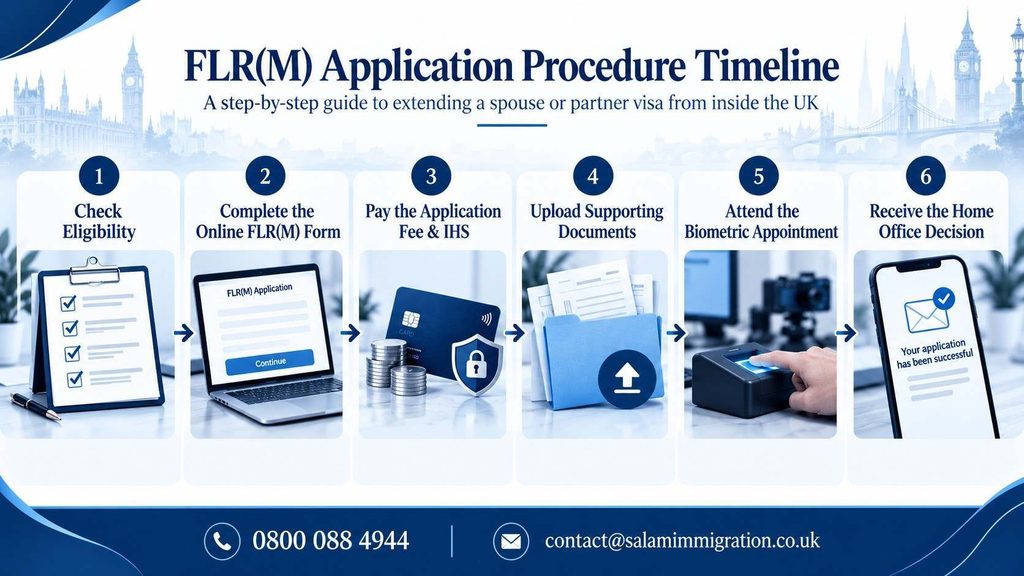
FLR(M) applications are submitted online through the UK government website. Paper forms have been withdrawn for most applicants, with narrow exceptions for certain fee-waiver cases. The online application form is the standard route.
Here is the application process, step by step:
- Create a GOV.UK account. Register on the UK Visas and Immigration online portal. You will need an email address you check regularly.
- Complete the FLR(M) form. The online application form asks for your personal details, immigration history, partner details, financial information, and details of any children or other family members included in the application. You must provide your current passport with the application.
- Pay the FLR visa fee and immigration health surcharge. Both payments are made through the online portal before you can proceed.
- Book a UKVCAS appointment. After paying, you select a biometric appointment at a UKVCAS centre near you.
- Upload supporting documents. Use the UKVCAS self-service portal to upload required supporting documents before your appointment. Supporting documents must be originals or certified copies. Documents not in English require a certified translation. Group files logically: relationship evidence, financial evidence, accommodation, English language, and other. Clear file naming saves time for both you and the caseworker.
- Attend your biometric appointment. Fingerprints and a digital photo are taken at the centre.
For a full list of what to upload, see our spouse visa document checklist.
FLR(M) Application Fees, IHS And Total 2026 Costs
FLR visa fee changes regularly. All figures below are correct at the time of but should be verified on GOV.UK just before you apply.
| Cost Item | Amount Per Adult | Notes |
| Home Office Application Fee | £3,407 | Per Applicant |
| Immigration Health Surcharge (30 Months) | £2,587.50 | £35/year, Paid Upfront For 2.5 Years |
| UKVCAS Biometric Appointment | Included Or Small Fee | Depends On Appointment Type |
| Super Priority Service (Optional) | £1,000 | Decision Within 1-5 Working Days |
Super Priority Service Can Expedite Processing For £1,000 On Top Of The Standard Fees. Availability Varies By Location And Demand, And Not Every UKVCAS Centre Offers It At All Times.
Get Expert Help With Your FLR(M) Application
Meeting the UK visa extension requirements can be challenging, particularly where finances, relationship evidence or immigration history are complex.
At Salam Immigration, our immigration solicitors assist spouse and partner visa holders with FLR(M) extensions, supporting documents, financial evidence and the route towards settlement. Whether you rely on employment, your own income, savings, self-employment or income as a business person, we can review your circumstances and help you prepare your application correctly.
Contact Salam Immigration today to discuss your application.
Biometrics, UKVCAS Appointments And EVisa Status
At your UKVCAS appointment, staff will check your identity documents, capture your fingerprints, and take a digital photograph. If you have paper documents that were not uploaded digitally, staff may scan them on the day. Children included on the FLR(M) application also need to attend for biometrics; the process is quick and straightforward.
After a successful FLR(M) application, your new immigration status is recorded digitally, and you will need to know how to prove your immigration status when employers, landlords or other bodies ask for confirmation. The Home Office has been phasing out physical biometric residence permit cards in favour of eVisa. You can view and prove your immigration status through your online UKVI account rather than relying on a physical card.
Do not travel outside the UK or the wider Common Travel Area while your FLR(M) application is pending. Leaving is treated as withdrawing the application, which creates serious immigration problems. You can usually keep your passport after biometrics, but avoid booking any international travel until you have received a decision and your new leave has been confirmed.
Section 3C Protection And Your Right To Work While Waiting
If you submit a successful application for FLR(M) before your current visa expires, Section 3C of the Immigration Act 1971 protects your right to stay in the UK. Your existing conditions, including permission to work and study, continue automatically until the Home Office makes a decision or any appeal is finished. Holders of an FLR(M) visa have unrestricted rights to work in the UK, and that same right carries forward under Section 3C while your extension is being considered.
For example, if you apply 7 days before your spouse visa expires, you can keep working for the same employer without interruption while the Home Office processes your FLR(M) application.
Employers may ask for proof that a further leave to remain application is pending. The Home Office runs an Employer Checking Service that can confirm your continued right to work. If your employer is unsure, direct them to that service.
Processing Times And What Happens After You Submit

FLR(M) processing time is typically 2 to 3 months under the standard service. Many straightforward applications are decided in around 5 to 8 weeks. Complex applications may take longer to process, particularly where the Home Office requests additional financial evidence or has questions about the relationship.
Super priority service, where available, can deliver a decision within 1 to 5 working days. Standard priority may cut the timeline to about 30 working days.
After submission, expect the following:
- Confirmation email once the online application form is successfully submitted
- Requests for further information (RFIs) if the caseworker needs additional supporting documents; respond within the timeframe specified
- Decision notice by email or post. You will receive a decision letter after processing. If approved, you receive 30 months of further leave with full work and study rights
If the FLR(M) application is refused, the decision letter explains the reasons and your rights. You may have a right of appeal or administrative review, usually within 14 or 28 days depending on the circumstances.
Keep copies of your full partner visa application, all uploaded documents, and the decision letter. You will need these when you later apply for indefinite leave to remain.
Your Path From FLR(M) To Indefinite Leave To Remain
A successful FLR(M) application brings you close to the 5-year residence mark needed for settlement. FLR(M) is part of the structured 5-year partner route under UK immigration rules, and careful planning at this stage makes the later settlement application much more straightforward.
To qualify for indefinite leave to remain after five years, you must:
- Pass the Life in the UK Test
- Show English at CEFR B1 level (higher than the A2 needed for FLR(M))
- Demonstrate continuous residence with limited absences abroad
- Still meet the relationship requirement: genuine and subsisting
- Meet suitability criteria with no serious criminal convictions or deception
Example timeline: If you entered the UK on a 30-month spouse visa on 20 January 2025 and successfully extend via FLR(M) in January 2027, you reach five years by approximately January 2030 and can apply for indefinite leave to remain at that point.
Frequently Asked Questions
1. What is an FLR(M) application?
FLR(M) is used by eligible partners applying from inside the UK to extend their permission to stay under the family route. Form FLR(M) commonly applies to spouses, civil partners and qualifying unmarried partners continuing their stay with an eligible partner.
2. Who is eligible to apply for FLR(M)?
You will generally need a qualifying relationship with a partner who is, for example, a British or Irish citizen, settled in the UK, holds qualifying pre-settled status or has certain protection status. GOV.UK also lists certain Turkish Businessperson or Worker status holders. A fiancé, fiancée or proposed civil partner normally needs to marry or form the civil partnership before extending as a partner.
3. What is the financial requirement for a spouse visa extension?
For most applicants under the current rules, the couple must usually show a combined gross annual income of at least £29,000. If the first successful partner application was made before 11 April 2024 and the applicant is extending with the same partner, transitional rules generally retain the £18,600 threshold. Qualifying own income earned by the applicant may also count.
4. What happens if I cannot meet the FLR(M) financial requirement?
Failing the standard financial requirement does not automatically mean every case must be refused. Limited exceptions may apply, including circumstances involving a qualifying child or where refusal could breach human rights. Cases involving a human rights claim require careful assessment because different requirements or settlement routes may apply.
5. Can children be included in an FLR(M) application?
Eligible dependent children can potentially be included. Children generally need to be under 18 when applying, or have held qualifying dependant permission since before turning 18, and must not normally be married, in a civil partnership or living an independent life.
This information is general guidance and does not constitute legal advice. Your eligibility and supporting evidence will depend on your individual circumstances.
Make Your FLR(M) Extension Simple
Visa · Settlement · Legal Support