The standard UK ILR processing time is currently up to six months from the date of your biometric appointment or successful ID Check app verification.
Many straightforward ILR applications are decided faster, often within 4 to 8 weeks, but the six-month window is a service target rather than a legal guarantee. Priority service usually aims for an ILR decision in around 5 working days, and super priority service targets a decision by the end of the next working day, where available.
Not all visa routes or locations offer priority or super priority, and availability can be paused at short notice. If you applied before your existing visa expired, you can generally stay in the UK under the same conditions while waiting for your settlement decision.
At Salam Immigration, our UK immigration team deals with Indefinite leave to remain cases and decision timelines every day. This guide covers how ILR takes under standard, priority, and super priority service, what affects your ILR application timeline, and what to do while you wait.
How Long Does an ILR Application Take?
Most applicants should plan for a decision within up to six months from their biometric appointment or ID Check app verification. That is the published customer service standard from UKVI for straightforward settlement applications.
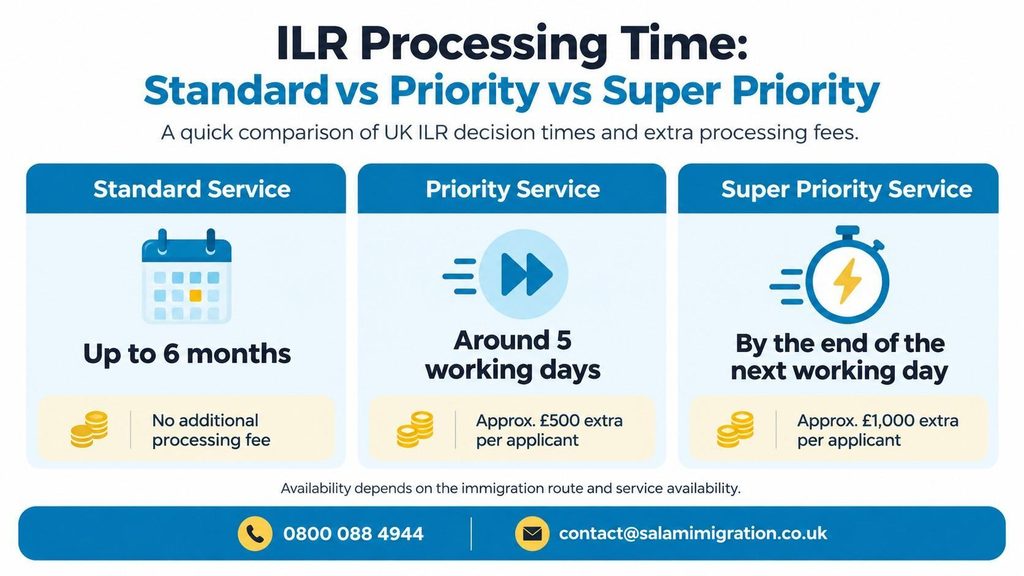
Here is how the three service levels compare:
| Service Level | Target Decision Time | Additional Fee (per person) |
| Standard service | Up to 6 months | None beyond the application fee |
| Priority service | Around 5 working days | Approximately £500 |
| Super priority service | Next working day | Approximately £1,000 |
The standard ILR application fee is £3,226 per applicant, and each dependent must pay the full ILR application fee individually. There is no immigration health surcharge for ILR applications, which is one fewer cost to worry about compared to other UK visa application stages. ILR fees have increased annually in recent years, so the current fee should always be confirmed before applying.
Priority service availability and super priority timescales are not offered for every visa route or every service point. Their availability can be paused at short notice depending on demand. For example, super priority service is currently suspended for new family visa applications.
A quick example
A skilled worker visa holder applying for ILR under standard service might wait 2 to 4 months for a straightforward case. The same applicant using super priority service could receive their decision by the end of the next working day after their UKVCAS biometric appointment, reducing ILR processing to one working day in the best scenario.
What Is the Current ILR Processing Time in Practice?
The official UK ILR processing time of up to six months is a published service standard. It is not legally binding on the Home Office, and UKVI is not required to meet it in every case.
In practice, many ILR applicants receive a decision well before six months. Community reports and recent applicant feedback suggest that straightforward cases are often decided within approximately 80 to 90 days.
Straightforward applications take 4 to 8 weeks when all supporting documents are clear and complete. Straightforward cases are likely to see faster processing times compared to complex cases.
However, complex ILR applications, or those needing extra checks, can take longer than the published ILR decision time. This is true even when no formal delay has been announced by UKVI. Applications submitted earlier in a processing cycle may be decided before later submissions, but this is not always the case.
Applicants can check current service updates and availability through the official GOV.UK Visa Processing Times Guide before submitting an application.
When Does ILR Processing Time Actually Start and End?
A common misunderstanding is that ILR processing time starts the moment you open the online form. It does not. The clock begins when you prove your identity.
For most in-country applications, that means:
- UKVCAS centre: ILR processing times start after biometric information submission, specifically when your fingerprints and photograph are taken at the biometric appointment.
- UK Immigration ID Check app: The processing time starts when the app confirms identity verification and your biometric information is successfully submitted.
UKVI counts the end of processing time as the date they send the email or letter with their decision. It is not when the BRP or digital status becomes visible in your online account. If you are applying as a family, dependants applying for ILR as a family member are usually decided at the same time as the main applicant, using the same start date for processing.
We recommend keeping a record of your application date, biometrics appointment date, and all UKVI correspondence. This helps you track your own ILR application timeline accurately.
How the ILR Application Process Affects Processing Time
ILR applications involve stages including eligibility checking, online submission, identity verification, and document review. Delays at any stage push back the overall timeline.
- Online application and fees: Completing the online form carefully matters. Errors or unanswered questions can trigger additional information requests. Applications submitted too early, before you have completed the required qualifying period, are automatically refused.
- Biometrics: UKVI rarely looks at an ILR application in depth before biometrics are provided. If biometric appointment availability is limited in your area or you delay booking, the start of your ILR processing is effectively pushed back.
- Supporting documents: Missing supporting documents trigger administrative delays in UKVI processing. Organizing documents into clearly labelled categories, such as finances, employment, English language test results, and identity, can help avoid delays. Applicants should ensure their tax records align with their employment records to meet suitability requirements, as inconsistencies here are a common cause of further evidence requests.
- Case complexity: The Home Office reviews continuous residence and background checks during application processing. Complex immigration histories, mixed evidence, or gaps in residence all require more detailed caseworker checks, extending the indefinite leave to remain processing time.
For a full overview of what documents and evidence you need, visit our ILR after 5 years guide.
Can You Get ILR Faster with Priority or Super Priority Service?
Yes, there are paid options to shorten the ILR processing time, but they are not available to every applicant.
Priority Service
Priority service aims for a decision within five working days after your biometrics or ID Check app verification. The additional fee is approximately £500 per person, on top of the standard application fee. Priority services incur additional fees on top of standard application fees, and these apply per applicant, including dependants.
Super Priority Service
Super priority service targets a decision by the end of the next working day following your UKVCAS appointment. If that appointment falls on a weekend or bank holiday, the decision may come within two working days. The extra fee is around £1,000 per person. Using paid expedited services significantly speeds up application processing compared to standard routes.
Important Limitations
- Not all visa routes allow priority or super priority services. Always check priority service availability when you reach the payment stage of your online application.
- Buying a faster service does not increase your chances of approval. It only aims to reduce the waiting time for a faster decision on your ILR application.
- If UKVI needs to make further checks or request further evidence, your application can still take longer than the advertised priority or super priority timescales.
Family example: A family of three applying under standard service would pay £3,226 each (£9,678 total). If all three chose priority service, the additional cost would be £500 each (£1,500 extra), bringing the total to £11,178. Each family member pays the premium services fee individually.
Why Can an ILR Application Take Longer Than Expected?
Extended ILR processing times do not always mean something is wrong, but there is usually a specific cause. Common reasons include:
- Missing or unclear documents: Incomplete evidence or inconsistencies between your remain application and your supporting documents almost always triggers a request for more information.
- Financial verification: This is the largest driver of family delays. The Home Office may need to verify income, savings, or tax records in detail, especially for family applications.
- Complex immigration history: Previous overstays, varied immigration routes, or criminal convictions will trigger additional checks by UKVI. Maintaining continuous residence is critical, and any deviations can complicate applications.
- Verification of foreign documents: Documents issued outside the UK can slow down processing because they may need to be verified with overseas authorities.
- Verification checks may require additional time if the Home Office needs to cross-check information with other government departments, employers, or third parties.
- Seasonal peaks or administrative backlogs can cause delays in application processing across the system, sometimes due to staff redeployment to humanitarian routes.
- An interview may be required in some cases, which can extend processing times further.
Complex applications may exceed standard processing times even with no fault on the applicant’s part. If your case is taking significantly longer than expected, professional advice from an immigration solicitor can help identify whether there is an issue worth chasing.
What Can You Do While Waiting for an ILR Decision?

If your ILR application was submitted before your existing visa expired, section 3C leave will usually extend your right to stay under the same conditions until a decision is made. This means you can continue to work, study, or live as before.
Here is what we recommend while you wait:
- Keep proof of your application. Save your submission email, payment receipt, and biometric appointment confirmation. Employers, landlords, and banks may ask for evidence of your pending application.
- Respond quickly to UKVI requests. If the Home Office asks for additional documents or information, reply promptly and clearly. Delays in your response will extend your indefinite leave to remain processing time.
- Check your email regularly. Look in your spam and junk folders too. Some Home Office deadlines for responses are short.
- Avoid strong assumptions. Do not make big personal circumstances decisions, such as resigning from a job or booking non-refundable travel, until you have a written settlement decision.
- Keep your contact details up to date with UKVI so that nothing gets lost.
What Happens After an ILR Decision?
If ILR Is Granted
You will receive a confirmation email or letter, and your digital status will be updated in your UKVI account. Where still issued, you may also receive a physical BRP card. With settlement status, you can usually work and study in the UK without time restrictions and access state benefits.
Many ILR holders later become eligible to apply for British citizenship by naturalisation after holding indefinite leave for 12 months. Some civil partner or partner applicants who are the settled person’s spouse can apply sooner. For details, see our naturalisation requirements guide.
If ILR Is Refused
You will receive written reasons for the refusal. Options may include administrative review, appeal where available, or submitting a fresh application if you are still eligible. For more on why applications fail, read our guide on common ILR refusal reasons.
Refusal after a long ILR application processing time can be very stressful. Early legal advice is strongly recommended to protect your future UK immigration options. Remember: the speed of an ILR decision, whether fast or slow, does not predict the outcome. Only the content and evidence of your well prepared application determines the result.
Special ILR Processing Time Considerations by Route
While the six-month service standard broadly applies, ILR processing times can differ between settlement routes.
- Skilled worker and Global Talent routes tend to have clearer documentation and often allow priority or super priority. These applicants frequently see faster timelines.
- Long residence route (10 years continuous residence) follows the same up to six months standard, but complexity around absences and mixed visa category history can extend decisions. See our ILR after 10 years page for more on this immigration route.
- Family and private life routes may involve more intensive third-party checks, especially around financial evidence, making the UK ILR processing time longer in practice.
- EU Settlement Scheme, refugee settlement, and domestic abuse routes require more detailed background checks. Premium services may not be available for these routes.
- Innovator Founder and returning resident visa routes may have different ILR application timelines depending on how evidence is assessed.
Applicants on less common or complex routes should not assume their application will match the fastest published times. If you are unsure, we can review your specific immigration history and visa route to give realistic expectations.
How Salam Immigration Can Help With Your ILR Application Timeline
Professional legal help can reduce avoidable delays in the ILR processing time. At Salam Immigration, we have handled more than 23,000 UK visas and settlement applications since 2018, including a high volume of ILR applications across different routes.
Each client works with a dedicated case adviser from our team of 20+ immigration lawyers. We plan your ILR application timeline, check your supporting documents, prepare a strong covering letter, advise on the best service level (standard, priority, or super priority), and liaise with UKVI where appropriate.
If you are unsure whether your application is ready, what evidence you need, or how your immigration history affects your ILR processing, speak to our UK immigration team for professional guidance.
ILR Processing Time FAQs
How long does ILR take in 2026?
Most standard ILR applications are decided within up to six months from the date of biometrics or ID Check app verification, although most applicants with straightforward cases receive a decision sooner. Priority and super priority options can reduce ILR decision time where available, for an additional fee.
Can ILR take longer than 6 months?
Yes. Indefinite leave to remain processing time can go beyond 6 months where the case involves complex immigration rules, more information is needed, or background checks take longer than usual. Keep your contact details up to date with UKVI and seek advice if there is a long delay with no explanation.
Can I track my ILR application status?
There is no detailed online service for tracking ILR in real time. UKVI will normally contact you by email once a decision has been made or if they need more information. If you paid for expedited processing through priority or super priority, you may be able to use paid enquiry routes if your application passes the advertised processing time.
Does priority service guarantee a faster ILR decision?
UKVI aims to make a faster decision under priority or super priority services, but there is no absolute guarantee if extra checks or documents are required. Paying for a faster service does not make approval more likely. It only affects the ILR processing time, not the outcome.
How long after ILR can I apply for British citizenship?
Many ILR holders can apply for British citizenship by naturalisation after holding indefinite leave for 12 months. Some partners of a British citizen can apply as soon as they obtain ILR.
Check Your ILR Eligibility and Start Your Application
Visa · Settlement · Legal Support