Many people ask us about skilled worker visa additional work rules in the UK and whether they can get an additional job. The short answer is yes, you can take a second job, but only within tight limits.
If you hold a Skilled Worker visa and a second employer, a freelance client or your own business has offered you extra work, you need to check the rules before you start. Take on the wrong kind of job, or work too many hours, and the Home Office can curtail your permission, your sponsor can lose confidence in you and future immigration applications can become much harder.
At Salam Immigration, we have handled over 23,000 immigration applications since 2018, and extra work is a question we hear regularly. This guide explains what counts as supplementary work, when you need a new certificate of sponsorship and how to stay on the right side of the immigration rules.
Quick Run-Through of Rules for Skilled Worker Visa Additional Work
The rules for permitted supplementary employment in the UK are:
-
Hours: no more than 20 hours per week of supplementary work in total.
-
Timing: the extra work must be outside your contractual working hours for your sponsor.
-
Main job: you must keep working in the sponsored job on your certificate of sponsorship.
-
Occupation: the second job must be in an eligible occupation code or on the Immigration Salary List.
-
Over 20 hours: you need a new certificate of sponsorship from the second employer and a visa update.
-
Voluntary work: permitted, but it must be genuinely unpaid.
What Supplementary Work Means for Skilled Worker Visa Holders
Your visa is tied to a specific sponsored job. However, the conditions of grant in Appendix Skilled Worker say that supplementary employment is permitted, providing the person continues to work in the job for which they are being sponsored.
In practice, supplementary work is paid work in addition to your main job. It can be a part-time role with another UK employer, freelance projects or work for your own business. You do not need a new certificate of sponsorship for it, and, if the work qualifies, you do not need to apply for a new visa or tell the Home Office before you start, provided every condition is met.
That last point matters. A second job is not automatically allowed just because you hold a Skilled Worker visa. Each condition below must be satisfied for every week you do the work.
The Conditions Your Second Job Must Meet
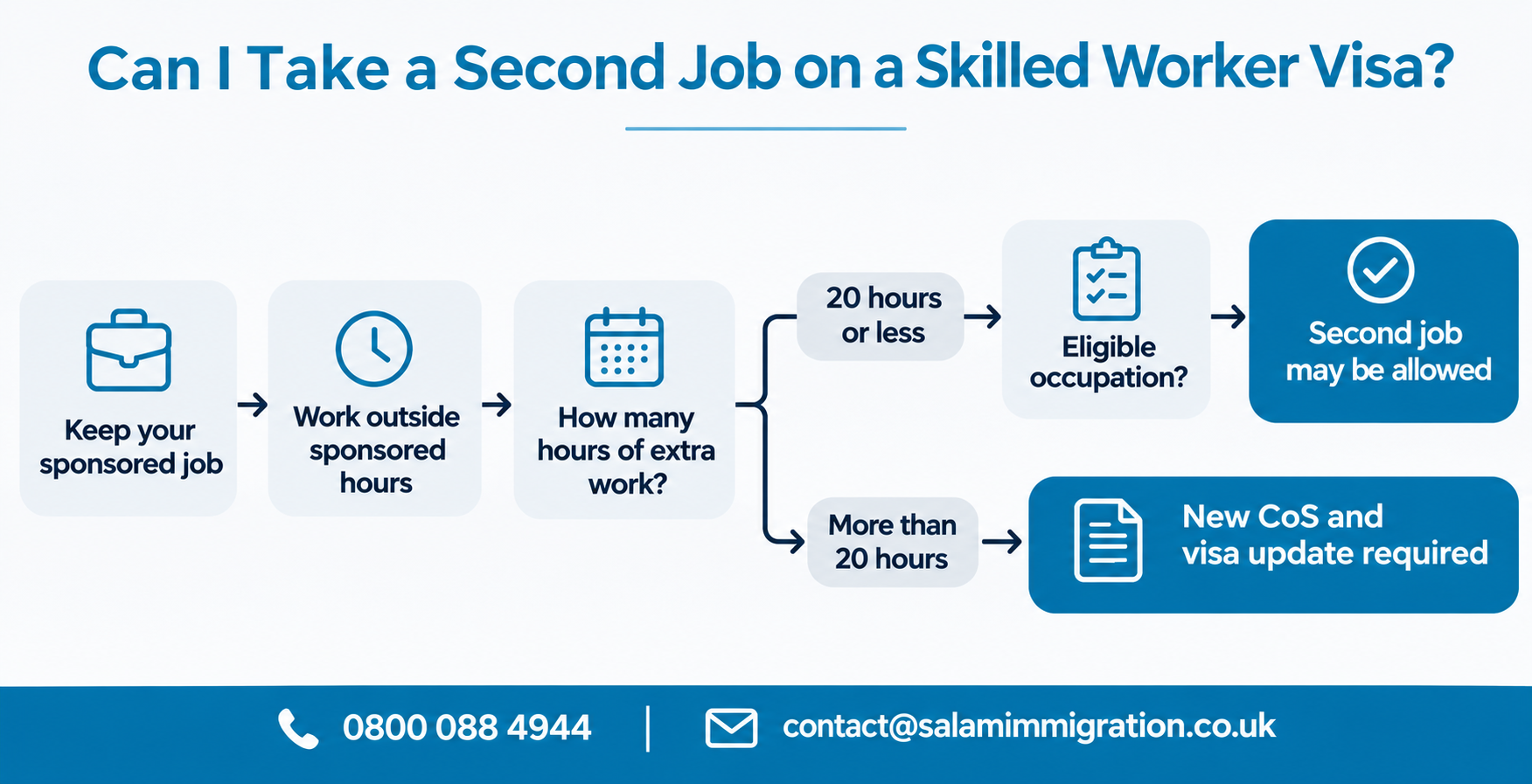
The rules on additional employment under the Skilled Worker route are cumulative. You must meet all of them, not just one.
-
Keep your main job: you must continue in the sponsored job, remain employed in that role with the sponsoring employer. Supplementary work cannot replace it.
-
Stay within 20 hours: you can work up to 20 hours a week in another job or for your own business, as long as you are still doing the job you are sponsored for.
-
Work outside your sponsored hours: the extra work must not overlap with main job hours you contracted for your current employer, and it must not interfere with your main role.
-
Choose an eligible occupation: the job must fall within the occupation tests explained in the next section.
If you hold more than one extra role, treat the 20 hours as a combined weekly total across all of them. Do not assume each job has its own allowance.
Which Occupations Qualify as Supplementary Employment
Since 22 July 2025, the second job must either be in an occupation listed in Tables 1, 1a, 2, 2aa, 3 or 3a of Appendix Skilled Occupations as the rules allow, or appear on the Immigration Salary List. In plain terms, the work has to be at a skilled level, broadly RQF level 6 or above, or be a shortage-style role on the Immigration Salary List.
The old test was different. Before April 2024, the rules asked whether the job was in the same profession, at the same professional level, and often in the same sector as your main job. That older approach no longer applies in the same way, so do not rely on advice or forum posts that refer only to the same profession or same level.
Transitional Protection for Existing Workers
There is one important exception. If you were granted permission as a Skilled Worker under the rules in place before 22 July 2025 and have held continuous permission since then, you can still take supplementary work in the lower-skilled occupations in Tables 1a, 2aa or 3a.
If you have had a gap in permission, or you first applied after that date, you will not benefit from this protection. Check your immigration history carefully before you accept a medium-skilled role. Our guide to Skilled Worker eligibility explains how the occupation and skill level rules fit together.
Examples of What Is and Is Not Allowed
-
Likely allowed: freelance software development for 10 hours a week, outside your sponsored hours, while sponsored as an IT professional.
-
Likely allowed: an after-hours consultancy role for a second employer, where the occupation code is eligible and the hours stay within 20.
-
Likely not allowed: weekend work in a role that is not in the eligible occupation tables, unless you qualify for the transitional protection.
-
Not allowed: any work during the hours you are contracted to work for your sponsor.
Your occupation code is recorded on your certificate of sponsorship, so start there. Then compare the second job’s occupation code, job title and duties with Appendix Skilled Occupations before you accept the offer.
Self-Employment and Running Your Own Business
Many Skilled Worker visa holders ask whether they can freelance or start a company. You can, but your own business is treated in the same way as any other second job. It must pass the same occupation test and fit within the same 20 hours.
Business administration counts too. Preparing invoices, answering client emails and keeping accounts all eat into your weekly allowance. Keep a simple log of your hours, because you may need to show it to the Home Office or a future decision maker.
Also remember that income from supplementary work does not help you meet the salary requirement. Only your sponsored salary counts, which is worth knowing when you plan your Skilled Worker visa minimum salary position.
Overtime, Voluntary Work and Unpaid Activity
Overtime in your sponsored job is different from supplementary work. If you work overtime for your current sponsor in the role on your certificate of sponsorship, you do not need to update your visa, and the overtime does not count towards the 20 hours. Make sure the duties stay within the job described on your certificate.
Voluntary work is also permitted under the conditions of grant. It should be for a registered charity, a voluntary organisation, an associated fundraising body or a statutory body, and a fundraising body that raises money for such causes can qualify. You can receive reasonable expenses such as travel and lunch, but nothing that looks like a wage.
Be careful with unpaid work for a commercial business. If it looks like a job in disguise, the Home Office may treat it as employment, which then has to meet the supplementary work conditions.

When You Need a New Certificate of Sponsorship (CoS)
If the second job needs more than 20 hours a week, or it is not in an eligible occupation, including where it falls under a different occupation code, it is no longer supplementary work. It becomes secondary employment, which needs fresh permission.
In that case, you will need to apply to update your visa so that you are sponsored to do both jobs. The steps are:
-
Start work in your first sponsored job. You cannot apply for secondary employment before you have begun it.
-
Ask the second employer, who must be a licensed sponsor, to assign you a new certificate of sponsorship.
-
Submit your application to update your visa, including a short letter or application explaining that you want to change your current permission to stay.
-
Wait for the decision and resolve any uncertainty before the worker begins the role. Do not start work on the assumption that approval will follow.
The second employer needs a valid sponsor licence for this route. Supplementary work is different, because that employer does not need to hold a licence.
Your current employer should also keep records for at least one year after sponsorship ends. If you are weighing up a move rather than an extra job, our guide on how to switch to a Skilled Worker visa explains the wider process.
Risks of Getting It Wrong and Compliance Actions
Working beyond the permitted hours, in an ineligible role or during your sponsored hours breaches your visa conditions and can affect your immigration status.
If a sponsored worker undertakes supplementary work that does not follow the above conditions, the serious consequences can include curtailment of permission, a refusal of future applications and pressure on the employer’s sponsor licence. You’ll receive a short period to leave the UK after curtailment.
Unauthorised work can trigger compliance action against sponsors also. Employers face penalties up to £60,000 for illegal workers.
How to Avoid Visa Curtailment and Other Consequences
Do the following to protect yourself:
-
Check the new job has the same occupation code and that the working pattern still fits the supplementary work rules before you accept it.
-
Keep contracts, payslips and invoices for every job.
-
Record your hours each week.
-
Tell both employers that you are on a sponsored visa, so they can complete right to work checks.
-
Do not stop your main job and continue only with the second one.
-
Do not count on side income to meet your salary threshold.
At Salam Immigration, our immigration advisors often review a client’s certificate of sponsorship, contract and the second job offer side by side before they commit. With more than 20 years of experience behind our team, we know that a quick check at this stage can prevent a breach that is expensive to put right.
Secondary Employment Compared With Supplementary Work
|
Point
|
Supplementary work
|
Secondary employment
|
|
Weekly hours
|
Up to 20 hours
|
Can exceed 20 hours
|
|
Timing
|
Outside your sponsored hours
|
As approved on the new certificate
|
|
Second employer
|
Does not need a sponsor licence
|
Must be a licensed sponsor
|
|
New certificate of sponsorship
|
No
|
Yes
|
|
Application to update your visa
|
No, if all conditions are met
|
Yes
|
Get Your Second Job Plans Checked Before You Start
Our team can confirm whether extra work fits your visa before you undertake supplementary employment. We offer services for:
-
Skilled Worker Visa: our immigration advisors check your SOC code, hours and sponsor details, and prepare an application to update your visa where a second sponsored job is needed.
-
UK Work Visas: if the extra work does not fit the Skilled Worker route, we advise on the right alternative visa route for your circumstances.
-
Indefinite Leave to Remain: we check that extra work and any changes of employer do not put your settlement plans at risk.
Frequently Asked Questions
Can I work two jobs on a Skilled Worker visa?
Yes, but only within limits. You can do up to 20 hours a week of supplementary work in an eligible occupation, outside your sponsored hours, while you continue in your main job.
Do I need to tell the Home Office about a second job?
No, not if the work meets every supplementary work condition. If it exceeds 20 hours or is not in an eligible occupation, you must apply to update your visa first.
Can I start my own business on a Skilled Worker visa?
Yes, if the work passes the same occupation test and stays within 20 hours a week, including business administration. You must also keep doing your sponsored job.
Does overtime count towards the 20 hours?
No. Overtime in the job you are sponsored for does not count towards the 20 hours and needs no visa update, provided the duties stay within your certificate of sponsorship.
Can I do voluntary work as well?
Yes. Voluntary work is permitted for a registered charity, voluntary organisation, associated fundraising body or statutory body, provided you receive no payment beyond reasonable expenses.
What happens if I work more than 20 hours?
You breach your visa conditions, which can lead to curtailment and problems with future applications. To work more than 20 hours lawfully, you need a new certificate of sponsorship and permission to update your visa.
Speak to an Immigration Adviser Before You Accept Extra Work
If you are unsure whether a second job is allowed under UK visas and immigration rules, our Skilled Worker Visa team can assess the role against your certificate of sponsorship and tell you whether you can proceed or need a new sponsor.
If you need to change your permission, our Skilled Worker Visa application support covers the new certificate, the supporting letter and the visa update from start to finish.
Speak to us in person, by phone or online through our contact page.
This article is general guidance, not legal advice.