If you visit family, attend business meetings or return for regular medical appointments in the UK, applying for a fresh visa every time is slow, costly and risky. A single refusal can disrupt a planned trip and leave a mark on your travel history.
A long-term Standard Visitor visa can remove much of that repetition, but only if you choose the right length and show the Home Office that you will remain a genuine visitor throughout.
The question most applicants want answered is simple: can I get a long-term Standard Visitor visa for the UK, and should I choose 2, 5 or 10 years? This guide explains what each option gives you, what it costs, what it does not allow, and how the Home Office decides which length to grant.
At Salam Immigration, with over 20 years of experience in UK immigration, we regularly see applicants misunderstand the most important point: a 10-year visa is not permission to stay for 10 years.
What Is a Long-Term Standard Visitor Visa UK?
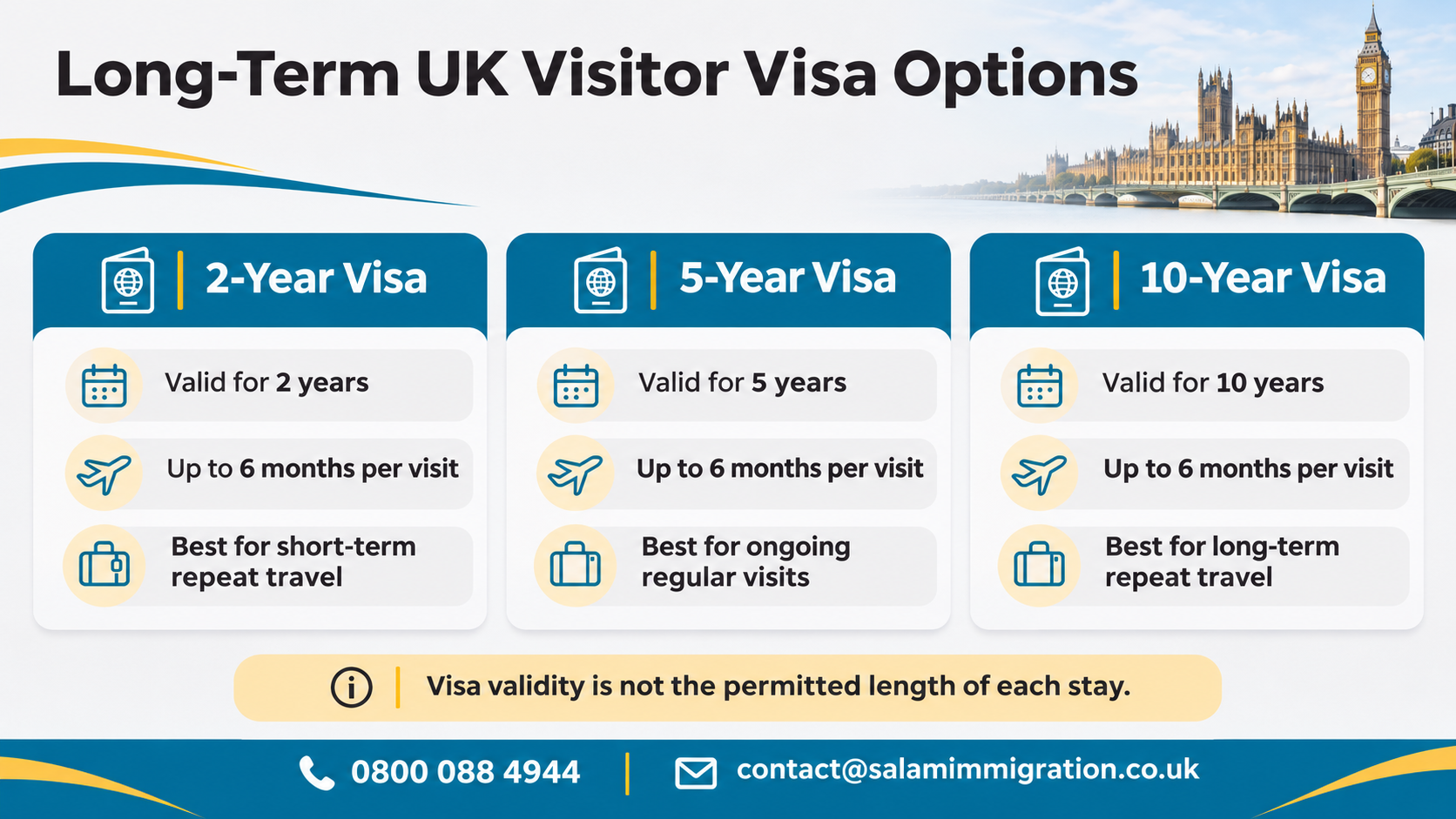
A long-term Standard Visitor visa is not a separate visa category. It is a Standard Visitor visa granted with extended validity, so that you can enter and leave the UK many times without applying again. If you visit the UK regularly, you can choose to apply for a long term visitor visa. This long term visa lasts 2, 5 or 10 years, and you can stay for up to six months on each visit.
You will also see it described as a multiple entry UK visitor visa, a UK multiple-entry visitor visa or a ten year visa. These all mean the same thing. The underlying permission is the same Standard Visitor visa used for a single trip, and the same visitor rules apply across all UK visas in the visitor route.
Under Appendix V of the immigration rules, within the period for which the entry clearance is valid, a Visitor may enter and leave the UK multiple times, unless the entry clearance is endorsed as single or dual entry.
The key difference is time. A standard six-month visa suits a one-off trip. A long term standard visitor visa suits frequent travellers who need repeated visits to the UK over several years, such as a grandparent who makes family visits each summer, a director who attends quarterly board meetings, or a patient who returns for follow-up appointments.
For under-18 applicants, the long-term visa is generally limited so that it runs only until six months after the child turns 18, so check the validity before you choose a length.
What You Can and Cannot Do on Multiple Visits to the UK on One Visa
A long term visitor visa does not widen what a visitor may do. The permitted activities are the same as on a shorter visa, and they are set out in Appendix Visitor: Permitted Activities. In practice they include:
-
Tourism and family visits: holidays, visiting friends, seeing relatives and attending family events.
-
Business activity: attending business meetings, negotiations, conferences and signing contracts. You may meet a UK company, but you cannot fill a role or deliver services to UK clients.
-
Short study: a recreational course of up to 30 days, or study of up to six months at an accredited institution. A student visa is needed for anything longer.
-
Volunteering: unpaid volunteering for a registered charity, limited to 30 days.
-
Medical treatment: private medical treatment, usually supported by a letter from the treating clinician.
-
Permitted paid engagement: a one-off paid engagement for an invitation by a UK-based organisation, within the narrow rules for that category.
-
School exchange programme: certain children can take part in a formal school exchange programme arranged through an approved UK school.
These are the only permitted activities, and anything outside them falls under prohibited activities. You cannot work for a UK employer, set up as a self employed person in the UK, claim benefits or access public funds. Those restrictions apply on every entry, however long the visa lasts. If you want to work, study for a long term or live in the UK, you need a different visa.
Our team can advise on routes such as the UK Skilled Worker visa if a job offer or ongoing employment is behind your plans.
Two-Year, Five-Year and Ten-Year UK Visitor Visa Compared
All three long term visitor visa options carry the same limit of up to six months per visit. What changes is the validity period and the fee. The fees are £135 for a standard visa, £506 for a 2 year long-term visa, £903 for a 5 year visa and £1,128 for a 10 year visa. These fees were current on gov.uk at the time of writing, so check the official page before you pay.
|
Option
|
Application fee
|
Maximum stay per visit
|
Best suited to
|
|
Standard Visitor visa
|
£135
|
6 months
|
A single trip or uncertain plans
|
|
Two-year UK Visitor Visa
|
£506
|
6 months per visit
|
Regular visits over a couple of years
|
|
Five-year UK Visitor Visa
|
£903
|
6 months per visit
|
Ongoing family or business visits
|
|
Ten-year UK Visitor Visa
|
£1,128
|
6 months per visit
|
Frequent visits and stable circumstances
|
Visitors do not pay the immigration health surcharge, because it applies to permission of more than six months. That is one reason a long-term visitor visa is cheaper than most work or family routes, although it gives you far fewer rights.
Is a Long-Term Visa Cheaper Than Several Short Visas?
Not always. The break-even point depends on how often you will actually travel. Four separate six-month visas at £135 cost £540, which is only slightly more than a two-year visa at £506. If you will visit the UK only once or twice, a shorter visa is cheaper. If you expect to visit every year for a decade, ten separate visas would cost £1,350, against £1,128 for one ten-year visa.
Fees are charged per person, and children pay the same as adults. A family of four choosing a ten-year visa for everyone pays four times the fee, so do the arithmetic for all family members before you decide.
Which Length Should You Choose?
Choose the length that matches a realistic, evidenced pattern of travel, not the longest option available. A request for ten years with no history of visiting the UK can look speculative, whereas a request that fits your applicant’s circumstances reads as credible.
-
Two years: suitable if you have a clear reason to visit repeatedly in the short term, such as a series of business meetings, a relative’s treatment or a new grandchild.
-
Five years: suitable if you have previous UK visits, ongoing family ties or a continuing business relationship, and your circumstances are stable.
-
Ten years: suitable if you have a long record of compliant travel, strong ties to your home country and a continuing need to visit the UK regularly.
There is no separate immigration rule that requires you to prove a recurring need, but your chosen duration should make sense in light of your circumstances. Evidence of previous UK visits, a family connection or a standing business arrangement makes a longer request easier to support.
Eligibility Requirements for a Long-Term Standard Visitor Visa
There are no separate eligibility criteria for a long-term visa. You must meet the same standard visitor eligibility requirements as someone applying for six months, and the Home Office then decides whether it is appropriate to grant entry clearance valid for several years.
Those visitor rules are in Appendix V of the immigration rules, which form part of wider immigration law.
The Genuine Visitor Requirement
The genuine visitor requirement is the heart of every application, and it is where most refusals arise. Under paragraph V 4.2, the applicant must satisfy the decision maker that they are a genuine visitor, which means they will leave the UK at the end of their visit, will not live in the UK for extended periods through frequent or successive visits, and are genuinely seeking entry for a permitted purpose.
For a long term standard visitor application, the Home Office is asking whether you are likely to remain one over the whole period you have requested, taking your applicant’s circumstances as a whole, including any financial commitments you have at home. That is why a clean immigration history, steady employment or business interests at home, and family or property ties abroad carry so much weight.
Officers at the UK border then assess each entry for genuine visitor intent, so the visa’s validity does not guarantee admission.
Funds, Documents and Your Valid Passport
You must show sufficient funds to cover all reasonable costs of each visit without working or relying on public funds. There is no fixed minimum amount in the rules. Funds may come from you or from a third party, provided there is a genuine relationship and clear evidence of support.
Typical supporting documents and supporting evidence include:
-
A valid passport or other travel document with enough validity for your planned travel.
-
Details of your travel history for the past 10 years, including previous UK visits.
-
Bank statements and payslips, or business accounts if you are a self employed person.
-
Evidence of your job, business or studies at home, your financial commitments and your home address history.
-
An explanation of why you need repeated visits, with an invitation letter or family evidence if relevant.
-
Letters from a treating clinician if the purpose is private medical treatment.
Documents not in English or Welsh need certified translations. Inconsistencies between your online form, your statements and your documents are a common reason for refusal, so keep every figure and date aligned.
If you are visiting a partner, spouse or civil partnership partner, remember that visits cannot replace a family route.
Frequent or Successive Visits: How Not to Live in the UK on a Visitor Visa
Repeated visits are the very reason for a long term visitor visa, but they are also its biggest risk. The rules do not set an annual limit, so there is no safe number of days to count towards. Instead, decision-makers look at your overall pattern of travel.
The immigration rules do not define “frequent or successive visits”, and Home Office guidance directs decision-makers to examine your travel history and the overall pattern of stay rather than apply a fixed formula.
Border Force officers may look at how many visits you have made in the past 12 months, how long each lasted and how much time you spent outside the UK between them. Those visitor rules apply equally to a long term standard visitor and to someone on a shorter visa.
Patterns that can attract scrutiny include:
-
Repeated stays close to the six-month maximum.
-
Leaving the UK briefly and returning straight away.
-
Spending more time in the UK than in your home country.
-
Holding UK accommodation, a GP registration or children in UK schools while visiting.
-
Working remotely for extended periods from the UK.
The consequences are real. Border Force can cancel your visa or issue a refused entry decision at the UK border, even if your visa is valid. Holding a visa does not guarantee entry, so carry your evidence of ties and funds each time you travel. A person who has been refused entry may also find later applications harder under immigration law.
Do keep a simple record of every trip, with dates in and out. Do keep your main home, job and family life outside the UK. Do not treat the six-month limit as a target. Do not do any work or business delivery in the UK that falls outside the permitted activities.
How the Home Office Decides How Long a Visa to Grant
The Home Office has discretion over the validity it grants. There are no published criteria setting out exactly how it decides between two, five and ten years. In practice, you may apply for ten years and be granted five, two or only six months if there are concerns about the longer period.
Where you are given a shorter visa than you asked for, you do not receive a refund of the fee difference. This is why choosing a sensible length matters. If you have never visited the UK, starting with a two-year request and building a record of compliant visits is often a safer route to a longer visa later.
At Salam Immigration, we often recommend applicants think about the grant they can realistically evidence, not the longest one they can request.
Previous UK Visits and Travel History
Previous UK visits that complied with their conditions are strong evidence. So are trips to other countries where you returned on time, such as the Schengen area, the USA, Canada or Australia. Any overstay, refusal or breach of conditions, whether in the UK or elsewhere, must be disclosed honestly. Deception can lead to a ban and affect later applications.
Who Needs a Visa and Who Needs an ETA?
The visitor route depends on your nationality. Visa nationals must apply for entry clearance before travelling. A non visa national can usually travel with an Electronic Travel Authorisation instead, which you request through the UK ETA app or online form. It is cheaper and quicker, although it is a different permission with different eligibility criteria and evidence.
If you hold an ETA nationality but have a previous refusal, a criminal record or a complex travel history, you may still choose to apply for a visa so that you can put your explanation and supporting documents in front of a decision-maker before you travel.
Check which permission you need before applying. Buying the wrong permission wastes money, because fees are not refunded.
How to Apply for a Long-Term Visitor Visa: Step by Step
You must apply for entry clearance from outside the UK before you travel. The application process is the same as for a six-month visa, except that you select the validity you want.
-
Confirm your route: use the official checker to confirm whether you need a visa, an ETA or neither.
-
Choose your duration: select two, five or ten years and be ready to explain why that length fits your travel.
-
Gather evidence: collect your passport, travel history, funds, ties and your reasons for repeated visits.
-
Apply online: complete the online application form on GOV.UK and pay the application fee for your chosen duration.
-
Attend your appointment: book and attend a visa application centre to give your fingerprints and photograph and to submit documents.
-
Wait for the decision: decisions on standard applications from outside the UK usually take around three weeks, though this can vary by location.
-
Check your vignette and dates: on receipt, check the validity dates and conditions are correct before you travel.
You can apply no earlier than three months before you travel. Priority services may be available at some centres for an extra fee, so check before you rely on one. Do not book non-refundable travel before you have a decision.
If You Are Refused or Given a Shorter Visa

A refusal is not the end of your options, but you should act carefully. A new application with the same weaknesses will probably meet the same result and cost you a second fee. Read the refusal letter closely, identify which part of the genuine visitor requirement was in doubt, and address it with better evidence.
Visitor refusals do not generally carry a full right of appeal, and the options depend on the type of application and the reasons given. Administrative review is not available for most visit visa refusals made outside the UK, so a fresh, stronger application is the usual remedy.
Our guide to the visa refusal challenge process explains what to check first. Do not rush to reapply without understanding why you were refused, and seek legal advice if the refusal alleges deception.
Common Mistakes That Lead to Refusal
-
Assuming a long grant means a long stay: a ten-year visa does not allow you to remain for ten years, and each visit is capped at six months.
-
Weak ties evidence: a vague job letter or missing proof of family and property at home.
-
Unexplained funds: large deposits or income that does not match your bank statements.
-
Requesting too long a period: asking for ten years with no travel history and no clear need.
-
Inconsistent answers: differences between your application, your invitation letter and your documents.
-
Blurring visit and work: describing business activity that looks like productive work for a UK employer.
Applicants with one of these issues often benefit from having their documents checked before submission. At Salam Immigration, we check your documents against what the Home Office expects under Appendix V before the application goes in, so gaps are fixed first.
When a Long-Term Visitor Visa Is the Wrong Choice
A visit visa is built for temporary stays. If your real aim is to live, work or study in the UK, using repeated visits will put you at risk of refusal, cancellation or a ban. Consider the proper route instead:
Choosing the correct route early is cheaper and safer than building a pattern of visits that later counts against you.
Get Your Long-Term Visitor Application Right With Salam Immigration
Our immigration solicitors and advisers help visitors, families and employers choose the right permission and present it clearly. These services fit most readers of this guide.
-
UK Family Visa: if your repeated visits are really about living with a partner, child or relative, we can advise on the family route that suits your situation rather than relying on visitor permission.
-
Unmarried Partner Visa: if you are in a long-term relationship with someone in the UK and visits are no longer enough, we can assess whether you qualify to apply as a partner.
-
Skilled Worker Visa: if your business trips are turning into UK work, we can explain when a sponsored work visa is needed instead of visitor permission.
Frequently Asked Questions
Can I stay in the UK for 10 years on a 10-year visitor visa?
No. A ten-year long-term Standard Visitor visa lets you enter and leave repeatedly over ten years, but each visit is limited to a maximum of six months. You must not use frequent or successive visits to live in the UK.
How many times can I visit the UK on a long-term Standard Visitor visa?
There is no fixed limit on the number of entries. However, every visit must meet the genuine visitor requirement, and a pattern that suggests you are living in the UK can lead to refusal of entry or cancellation.
Is there a 180-day rule for visitors?
No. There is no rule that allows 180 days in any 12 months, and no formal annual cap. Decision-makers look at the overall pattern of your visits and whether you are effectively making the UK your main home.
Can the Home Office give me a shorter visa than I applied for?
Yes. If it has concerns about the longer period, it can grant two years, five years or six months instead of what you requested. The fee is not refunded.
Do I pay the immigration health surcharge on a visitor visa?
No. Visitors do not pay the immigration health surcharge on a Standard Visitor visa, whatever its validity. You pay only the application fee for your chosen duration, though you may need to cover private medical treatment costs yourself.
Can I work or claim public funds on a long-term visitor visa?
No. You cannot work for a UK employer or access public funds. You must be able to support yourself during each stay without working, and any work beyond the narrow permitted activities can lead to refusal or cancellation.
Speak to Salam Immigration About Your Visitor Visa Plans
If you are unsure whether to apply for two, five or ten years, or you have a previous refusal to deal with, our team can review your history and evidence before you apply.
Our UK family visa advisers can also tell you if a family route would serve you better than repeated visits. If you have been refused, our advisers can explain the best next step, including a stronger new application. To book a consultation in person, by phone or online, contact our Manchester head office through our contact page.
Note: This article is general guidance, not legal advice. Fees and rules change, so check GOV.UK and seek legal advice on your own circumstances before you apply.