The EEA family permit route has closed, but many people still search for “eea family permit” because old documents, family rights and EU Settlement Scheme options can still matter. The practical replacement is usually the EU Settlement Scheme family permit, although some families must now use another UK family visa route.
An EEA family permit was free entry clearance for non eea nationals who were non eea family members of an EEA or Swiss citizen to come to the UK for up to six months, usually before 30 June 2021.
The EEA Family Permit route is now closed, and new applications cannot be submitted; eligible applicants must instead apply for the EU Settlement Scheme Family Permit. Most new applicants need a settlement scheme family permit or another route under the immigration rules, depending on the relationship and whether the sponsor has pre settled status or settled status.
Family members who already hold an EEA family permit, valid residence card, EEA residence card or permanent residence document may still need that history when applying under the eu settlement scheme.
Salam Immigration is an OISC-regulated UK immigration firm, advising on family permits, EU Settlement Scheme applications, appeals and British citizenship.
What is the EEA Family Permit?
An EEA family permit was a type of entry clearance that allowed non-EEA family members to travel to and enter the United Kingdom to join or accompany an eea or swiss citizen who was exercising free movement rights before the end of the Brexit transition period.
The EEA family permit was issued under the EEA Regulations, was normally valid for six months, and allowed multiple entries to the UK during that period. It was not the same as permanent residence. In many cases, it was the first step before applying for an EEA residence card, or later, for status under the EU Settlement Scheme.
In simple terms:
- EEA family permits were historic travel documents for an EEA family member.
- A family permit allowed eligible relatives to enter the UK without paying an application fee.
- An EEA family member visa is a common search phrase, but the legal term was EEA family permit.
- A European economic area family connection had to be proved with evidence.
- The EEA family permit route is now closed to new applicants, so people in similar positions today normally use an EUSS family permit or another UK route.
You can read the current official position on GOV.UK family permits.
What is the European Economic Area and Who Is an EEA Citizen?
The European economic area includes the European Union countries plus Iceland, Norway and Liechtenstein. Switzerland is not an EEA state, but a swiss citizen and swiss national were treated in a similar way for UK free movement rights before Brexit.
For EEA family permit purposes, EEA nationals generally meant:
- Citizens of EU countries, meaning nationals of an EU country within the European Union.
- Citizens of the EFTA EEA states: Iceland, Liechtenstein and Norway.
- Swiss nationals, because a Swiss citizen living in the UK was usually treated similarly under the old framework.
An eea citizen or eea nationals could enter, live, work, study and bring eligible family members of EEA nationals to the UK under EU law, provided the rules were met. British citizens did not usually have the same free movement sponsorship rights in the UK, although a British citizen could sometimes rely on the Surinder Singh route after living in another EEA country.
This framework also explains phrases such as EEA national family member, eea member state and european economic area family. Today, an EEA citizen with settled status or pre settled status can, in many cases, still sponsor a close family member under the EU settlement scheme family rules.
Who Qualified as a Family Member for an EEA Family Permit?
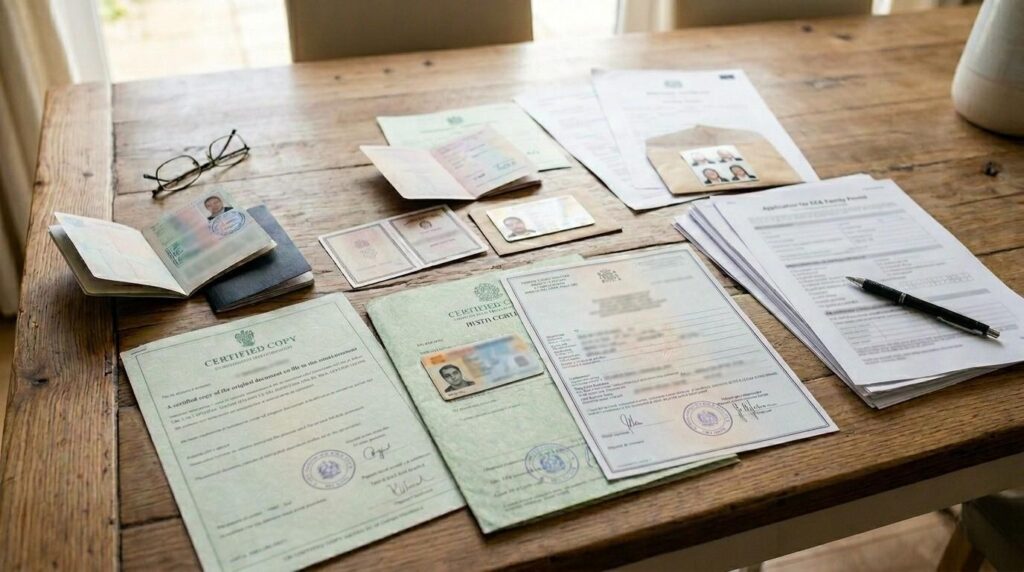
Eligibility for an EEA family permit depended on whether the applicant was a qualifying family member or extended family member of an EEA citizen or Swiss national. To qualify for an EEA Family Permit, applicants must demonstrate that they are a close family member of an EEA national, which includes spouses, civil partners, children, and dependent relatives.
Direct family members included:
- A spouse, usually evidenced by a marriage certificate.
- A civil partner, usually evidenced by a civil partnership certificate.
- A child under 21.
- A dependent child over 21.
- A dependent parent or grandparent of the EEA citizen or their spouse or civil partner.
Extended family members could include:
- Dependent siblings, aunts, uncles, cousins, nephews and nieces.
- An unmarried partner in a durable or long term relationship of at least two years.
- In complex cases, relatives such as a great grandparent or great grandchild needed careful legal analysis.
All categories required evidence of a genuine family relationship. An extended family member also needed evidence of dependency, membership of the same household abroad, or serious health reasons requiring personal care. Financial support alone was not always enough unless it showed real dependency.
Eligible relatives under the EUSS Family Permit include spouses, civil partners, durable partners, children under 21, and dependent parents or grandparents. Some extended relationships now have fewer options, so the correct UK family visa route must be checked carefully.
Core Eligibility Criteria for an EEA Family Permit
An EEA family permit application had to satisfy relationship and residence conditions. The applicant also had to show that the EEA sponsor was exercising relevant rights in the UK.
Key conditions included:
- Applications for an EEA Family Permit must be made from outside the UK, and there is no application fee for this permit.
- The applicant had to be joining or accompanying an EEA or Swiss citizen coming to, or already living in, the UK.
- The EEA citizen was usually required to be a “qualified person” if they had been in the UK for more than three months.
- A qualified person could be a worker, self-employed person, student, self sufficient person, or genuine jobseeker.
- If the EEA citizen had lived in the UK for at least five years and held a permanent residence document or settled status, that often gave a stronger basis for the family permit and later residence.
For British citizens, the Surinder Singh route sometimes allowed non-EEA family members to apply as if the sponsor were an EEA citizen. This generally required the British citizen to have lived genuinely in another EEA state before returning to the UK. Cases involving held British status, dual British nationality, dual citizenship or Irish citizenship can be technical, especially if the sponsor is also an Irish citizen.
Documents and Evidence for an EEA Family Permit Application
Documentary evidence was critical to any EEA family permit application. Missing documents, weak explanations and inconsistent dates were common reasons for refusals.
Typical evidence included:
- Identity documents: valid passport evidence for the applicant and sponsor, a national identity card where relevant, previous visas, or another immigration document.
- Relationship evidence: a marriage certificate, civil partnership certificate, birth certificate, adoption order, photographs, messages and travel records.
- Durable partnership evidence: joint bank statements, tenancy agreements, shared bills, children’s birth certificates and evidence of a long term relationship.
- Financial and residence evidence: payslips, employment contracts, self-employment records, bank statements, tenancy agreements, utility bills and comprehensive sickness insurance where required.
- Dependency evidence: proof of regular financial support, medical evidence, household records or evidence showing why the applicant needed the sponsor’s help.
To apply for an EEA Family Permit, the applicant must provide evidence of their relationship to the EEA national, such as marriage certificates or birth certificates, and any documents not in English must be translated. When applying for a family permit, the applicant must provide English translations of any documents that are not in English. Similar standards still apply when preparing evidence for an EU Settlement Scheme application, whether for a family permit or settled status.
How Long Did an EEA Family Permit Last and What Rights Did It Give?
An EEA family permit was normally issued for six months and allowed multiple entries to the UK during that period.
The main rights were:
- Holders could live, work and study in the UK while the EEA citizen continued to meet the relevant conditions.
- There was no general restriction on employment type or working hours.
- The EEA Family Permit is valid for six months, and if the holder wishes to stay longer, they must apply for an EEA Residence Card or the EU Settlement Scheme.
- Upon arriving in the UK, family members must apply to the EU Settlement Scheme to secure their long-term Pre-Settled status before the 6-month permit expires.
- After Brexit and the 30 June 2021 deadline, late applications may still be possible where there are reasonable grounds.
- An EEA family permit did not itself lead directly to British citizenship, but it could be an early step towards settled status and later naturalisation.
If someone tried to travel on an expired or invalid document, they could face refused entry. That is why checking current immigration status before travel is essential.
From EEA Family Permit to EU Settlement Scheme Family Permit

The EEA Regulations and traditional EEA family permit route have been replaced in practice by the EU Settlement Scheme family permit and the post-Brexit Immigration Rules.
Here is the key comparison:
- The EU Settlement Scheme Family Permit is available to non-EEA citizens who wish to join or accompany a close family member who is a relevant EEA citizen, while the EEA Family Permit was specifically for non-EEA family members of EEA nationals.
- The EU Settlement Scheme Family Permit is available to non-EEA citizens who wish to join or accompany a close family member who is a relevant EEA citizen or an eligible British citizen.
- To apply for a family permit, the applicant must be outside the UK and can only apply if the family member in the UK has pre-settled or settled status.
- Applications for the EU Settlement Scheme Family Permit can only be made from outside the UK, and there is no application fee for this permit.
- The application for a family permit is free of charge and does not require payment of the Immigration Health Charge.
- The EU Settlement Scheme Family Permit is valid for 4 months for those arriving after April 1, 2021, whereas the EEA Family Permit was valid for 6 months before its closure.
- The EU Settlement Scheme Family Permit is valid for 4 months if the applicant arrives in the UK after 1 April 2021, and they must apply for pre-settled or settled status within 3 months of arriving.
- To qualify for an EU Settlement Scheme Family Permit, applicants must demonstrate that their relationship with the EEA citizen existed prior to 31 December 2020.
- To be eligible for the EUSS Family Permit, the applicant must provide evidence that living in the UK started before 31 December 2020, and must hold Settled or Pre-Settled Status under the EUSS.
In practice, if you want to move to the UK under an EU Settlement Scheme family permit, you need to prove both the relationship and the sponsor’s status. This is especially important for families connected with Northern Ireland, an eligible person under Appendix EU, or mixed-status families.
Common Reasons for EEA Family Permit Refusal (and How to Avoid Them)
Although the EEA family permit has closed, old refusal reasons still help applicants prepare stronger EU Settlement Scheme family permit applications or late EEA-based cases.
Common issues included:
- Doubts about whether the relationship was genuine or continuing.
- Lack of evidence of dependency for a dependent child, dependent parent or extended relative.
- Insufficient proof that the EEA citizen was working, self-employed, studying, self-sufficient or otherwise a qualified person.
- Inconsistent dates across forms, passports, bank statements and relationship documents.
- Missing certified translations for non-English or non-Welsh documents.
- Surinder Singh refusals where the family could not prove genuine residence together in another EEA country before returning with a British citizen sponsor.
A strong visa application should include accurate forms, organised evidence and a detailed covering letter explaining complex family history or gaps in documents. If an application is refused, options may include administrative review, a fresh application or an appeal. Expert advice can make a decisive difference.
How Salam Immigration Can Help with Family Permits and Status in the UK
Salam Immigration is a specialist UK immigration law firm regulated by the Office of the Immigration Services Commissioner. We focus on visas, settlement and nationality applications, including family permits and EU Settlement Scheme matters.
Salam Immigration’s professional immigration lawyers can help with:
- EU Settlement Scheme family permit applications for relatives who want to come to the UK.
- Late applications for pre-settled or settled status.
- Moving from old EEA documents to the current immigration system.
- Complex family relationships, including durable partners, extended relatives and mixed-status families.
- Full application preparation, document checking and legal representations to UK Visas & Immigration.
- Administrative reviews, appeals and refusal advice.
- Next steps after settled status, including british citizenship by naturalisation.
If you are unsure whether your old EEA family permit, EEA family members’ documents or current immigration status can still be relied on, contact our expert immigration lawyers to get your case reviewed before you travel or apply.
Frequently Asked Questions
Is the EEA family permit still available in 2026?
No. The traditional EEA family permit under the EEA Regulations is closed to new applications. It effectively ended when free movement rights were repealed and replaced by the EU Settlement Scheme and the current Immigration Rules.
People in a similar position today generally need to apply for an EU Settlement Scheme family permit or another family visa route, depending on the sponsor’s status and when the relationship was formed.
If you still hold an old EEA residence card, EEA family permit or another EEA document, seek tailored legal advice before travelling or applying.
Can I apply for EEA family permit in the UK?
No. Historically, an EEA family permit application always had to be made from outside the UK. It was an entry clearance document, not an in-country visa.
If you are already in the UK and relying on a relationship with an EEA or Swiss citizen, you would normally look at an in-country EU Settlement Scheme application or a standard family visa. Remaining without lawful status can damage future applications, so early professional advice is important.
Can I work in the UK with an EEA family permit or EU Settlement Scheme family permit?
Yes. Holders of a valid EEA family permit could work, study and live in the UK while their EEA sponsor was exercising treaty rights. There were no general restrictions on the type of employment.
Holders of an EU Settlement Scheme family permit can usually work during the permit’s validity, but they should check the wording of their vignette and apply promptly for pre-settled or settled status if eligible. Employers may ask for digital evidence of status, so keep decision emails and share codes safe, and many applicants use specialist immigration solicitors in London or elsewhere for tailored advice.
Does an EEA family permit lead to British citizenship?
An EEA family permit did not directly lead to British citizenship. It often formed the first step in a longer process: residence in the UK, obtaining permanent residence or settled status, and then applying to naturalise as a British citizen.
Most applicants must hold settled status or another form of indefinite leave to remain for at least 12 months before applying for British citizenship, unless married to a British citizen. They must also meet residence, language, Life in the UK and good character requirements.
What if I missed the EU Settlement Scheme deadline?
The main deadline for many EEA citizens and family members was 30 June 2021, but late applications can still be accepted where there are reasonable grounds, such as vulnerability, serious illness or lack of awareness in specific circumstances.
Joining family members of EEA citizens with settled status or pre settled status may still have ongoing routes, including the EU Settlement Scheme family permit from outside the UK. If you believe you had rights under the old EEA system, get case-specific legal advice before deciding your next step.
Get Expert Guidance on Your EEA Family Permit
Visa · Settlement · Legal Support